Best NPC Generators for Dungeons & Dragons in 2026
The best NPC generators for D&D in 2026, compared. AI-powered tools that produce names, personalities, motivations, secrets, and plot hooks. Tabletop Arc, Donjon, Eigengrau, MyArchivist, Kassoon, and Chaotic Shiny ranked for D&D 5e DMs.
What is the best NPC generator for D&D in 2026?
The best NPC generator for D&D in 2026 is the free [Tabletop Arc NPC Generator](/tools/npc-generator) — a coherent character profile (name, race, class, personality, motivation, secret, quirk) in 3–5 seconds, no signup. Donjon and Kassoon remain strong for fast 5e mechanics, Eigengrau for procedural detail, and MyArchivist if you want NPCs tied to campaign notes. Pick AI-driven tools for narrative depth, table-driven tools for raw mechanics.
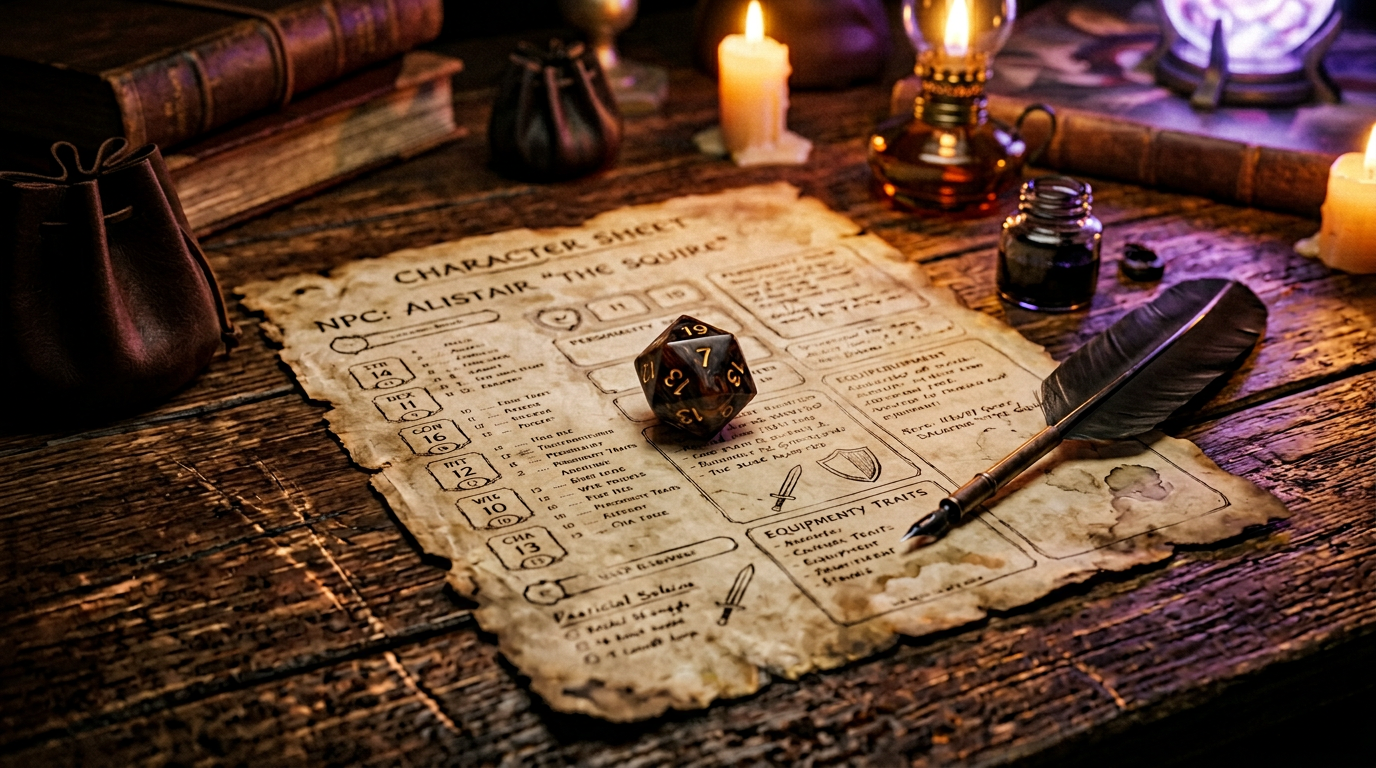
Want one now? The free Tabletop Arc NPC Generator builds a full D&D 5e character — name, race, class, personality, motivation, secret, quirk — in about 3 seconds. No signup.
Introduction
Game Masters are always one player question away from needing a new NPC. The blacksmith's cousin, the guard who was there that night, the merchant with the wrong kind of spices — the table constantly demands names, personalities, and reasons to care. Manually writing every supporting character burns prep time and still leaves you scrambling when the party goes off-script. AI NPC generators solve that: tools like the Tabletop Arc NPC Generator produce ready-made D&D 5e characters in seconds — with motivations, secrets, and plot hooks baked in — so you can focus on running the game instead of filling index cards. This guide covers the best NPC generators for D&D in 2026, with a focus on AI-powered tools that deliver depth and feed directly into a campaign memory layer.
What is an NPC generator?
An NPC generator is a tool — often AI-driven — that creates non-player characters for tabletop RPGs. You usually provide a few inputs (setting, tone, role, or theme), and the generator returns a character with some combination of:
- Name — Fitting the setting and culture.
- Role or class — Blacksmith, guard, wizard, merchant, etc.
- Appearance — A line or two so you can describe them at the table.
- Personality — Traits, mannerisms, or a short summary so you know how they act.
- Motivation or backstory — Why they’re here and what they want, so they feel grounded.
- Plot hooks — A secret, a connection to the world, or a problem that can drive drama.
Traditional generators (e.g. random tables) give you raw stats or one-line traits. AI NPC generators produce coherent, multi-sentence profiles: a character you can drop into a scene with minimal tweaking. The best ones output structured fields (name, race, class, personality, motivation, secret, quirk) so the result is easy to scan and use mid-session. That’s why searches for “NPC generator D&D” and “AI NPC generator” have grown: GMs want speed and depth without the blank page.
Best NPC generators for D&D
Here’s how several popular options compare. “Type” indicates whether the tool is AI-based or rule/table-based; “Strengths” summarise what each does well.
| Tool | Type | Strengths |
|---|---|---|
| Tabletop Arc NPC Generator | AI | Free. Theme, setting, tone, and optional detail. Outputs name, race, class, appearance, personality, motivation, secret, quirk. Fits into Tabletop Arc's campaign pipeline so NPCs become Lore Wall entries with evidence-grounded continuity across sessions. |
| Donjon NPC Generator | Rule-based | Fast, no account. Generates D&D 5e-style NPCs with stats, name, race, class, and brief traits. Good for "I need a guard or merchant now." Less narrative depth than AI. See Donjon vs Tabletop Arc. |
| Kassoon NPC Generator | Rule-based | Long-standing community generator with stat blocks and short backgrounds. Good for quick mechanical NPCs. See Kassoon vs Tabletop Arc. |
| Eigengrau NPC Generator | Mixed | Generates detailed NPCs with backstory, personality, and hooks. Often used for inspiration; output can be lengthy. Free to use. |
| MyArchivist AI NPC Generator | AI | AI-generated NPCs with backstory and personality. Tied into MyArchivist's campaign organisation so characters can live in your notes. |
| Chaotic Shiny NPC Generator | Rule-based | Long-standing random generators for names, traits, and oddities. Many tables; good for quick, quirky one-off NPCs. No single "profile" output. |
| ChatGPT (free) | Conversational AI | Best for ad-hoc dialogue and improvisation. No structured output, no campaign memory. Pair with Tabletop Arc to keep canon. See ChatGPT vs Tabletop Arc. |
For AI-generated characters with a clear structure (personality, motivation, secret, quirk), the Tabletop Arc NPC Generator is built for D&D 5e and similar fantasy TTRPGs. You choose theme (e.g. dark fantasy, high fantasy), setting (city, dungeon, court), and tone, and get a full profile in one click. If you need a name in a pinch, pair it with our Name Generator for culturally consistent options.
Try the NPC Generator free — no signup required →
Why AI NPC generators are better for modern campaigns
Older tools gave you a name and a stat block. Modern campaigns often expect dynamic storytelling, campaign continuity, and plot hooks that pay off over time. AI NPC generators support that in three ways.
Dynamic storytelling — When the party talks to someone you hadn’t planned, you need a character who feels real in the moment. AI can generate a personality, a quirk, and a motivation on the spot, so the scene doesn’t fall flat. You’re not reading a generic “merchant” line; you have a person with a goal and a secret.
Campaign continuity — Recurring NPCs need to be consistent. A good AI profile gives you a written record: how they look, what they want, what they’re hiding. That becomes your source of truth for future sessions. When you use a campaign management tool (see below), that profile can live in your Lore Wall so the whole table stays on the same page.
Plot hooks — The best AI NPC generators include a secret or motivation that can drive story. A blacksmith who is secretly funding the rebellion, a guard who recognises a PC from a wanted poster — those aren’t random; they’re built into the profile. You get ready-made hooks without having to invent them under pressure.
Example AI-generated NPC
Here’s the kind of output you can get from an AI NPC generator (e.g. Tabletop Arc’s), with theme “dark fantasy” and setting “city”:
Name: Maren Voss
Race: Human
Class / Role: Former soldier, now a smith’s apprentice
Appearance: Gaunt, short-cropped hair, a burn scar along one forearm. Wears a worn leather apron and rarely meets anyone’s eyes.
Personality: Terse and guarded. Speaks in short sentences. Doesn’t offer information unless asked directly. Shows a flicker of warmth only when discussing metalwork or old campaigns.
Motivation: Maren left the army after refusing an order they couldn’t live with. They’re trying to build a quiet life at the forge and avoid attention — but they still watch the streets for faces from the past.
Secret: They didn’t just refuse the order; they helped the intended victims escape. If their former commander finds them, the whole city could be at risk.
Quirk: Traces the edge of their scar when lying or nervous.
A profile like this gives you everything you need to run the NPC in one place: how they look, how they act, what they want, and what could blow up later. That’s the level of depth AI NPC generators are built to deliver.
Using NPC generators with campaign management tools
Generating an NPC is only the first step. If that character matters — they recur, they have a secret, they’re tied to a quest — they need to live in your campaign lore and be tracked across sessions. Otherwise you’ll forget their motivation, misremember their secret, or contradict yourself when the party returns.
Campaign management tools give you a single place to store NPCs (and locations, items, quests) so they’re searchable, linkable, and consistent. When you use an NPC generator, the ideal workflow is: generate → drop into a scene → then add the NPC to your campaign wiki with the same name, role, and key details. From then on, that entry is the source of truth. New sessions can reference it; future recaps can tie events to it; and you can attach evidence (e.g. “we learned this in Episode 3”) so the canon stays accurate.
Tabletop Arc’s campaign knowledge system is built for this. The NPC Generator gives you a structured profile. When you run sessions in Tabletop Arc, the pipeline transcribes audio, suggests entities (including NPCs) from the transcript, and lets you approve them into the Lore Wall — your campaign wiki. So you can use the generator for prep, and when that NPC shows up in play, they can be extracted from the session and merged into the same lore. You get one continuity loop: generate, play, capture, and reuse.
What's the bottom line?
NPC generators save preparation time and give you characters with personality, motivation, and plot hooks — not just a name and a stat block. AI NPC generators in particular deliver full profiles you can use at the table immediately. Compare options by type (AI vs rule-based) and by how well they fit your workflow; if you care about campaign continuity, choose a tool that plugs into a campaign management system so your NPCs become lasting lore.
Try the Tabletop Arc NPC Generator for free — and when you’re ready to turn those NPCs into a living campaign wiki, run your campaign with Tabletop Arc.
Try it yourself — generate a free NPC right now
No sign-up required. Generate NPCs, quests, locations, and more.
Frequently Asked Questions
What is the best free NPC generator for D&D?
Can I use AI to generate NPCs?
How do I save generated NPCs to my campaign?
Do NPC generators work for systems other than D&D?
Is this tool free to use?
Related Tools
Related Articles
D&D NPC Generator: Create Campaign-Ready Characters Fast
Use a D&D NPC generator to create names, roles, secrets, motivations, and plot hooks you can drop into tonight's session.
How to Create Memorable NPCs for D&D
A practical framework for creating NPCs players remember: role, desire, pressure, secret, voice, and campaign callback.
Random NPC Ideas for D&D: 25 Characters You Can Use Tonight
Steal 25 random NPC ideas for D&D, then generate variants with names, secrets, motivations, and hooks.
Villain NPC Generator: Build Better Antagonists for D&D
Create villain NPCs with motives, masks, pressure points, secrets, and hooks that make antagonists useful in play.
Shopkeeper NPC Generator: Better Merchants for D&D
Create memorable shopkeeper NPCs with inventory hooks, personalities, secrets, bargaining style, and reasons to return.
AI Tools for Dungeon Masters: Generate NPCs, Quests, Dungeons and More
TabletopArc is an AI-powered toolkit for Dungeon Masters that helps generate NPCs, quests, towns, dungeons, encounters, names, taverns, and magic items for tabletop RPG campaigns — so you spend more time playing and less time prepping.
Best AI Tools for D&D Campaigns 2026: Ranked Comparison
The best AI tools for D&D campaigns in 2026, ranked. Compare Tabletop Arc, ChatGPT, Donjon, World Anvil, Foundry VTT, Obsidian, and Friends & Fables for prep speed, session transcription, campaign continuity, and worldbuilding — with free tiers compared.
Best Campaign Management Tools for D&D and TTRPGs in 2026
The best campaign management tools for D&D and TTRPGs in 2026, ranked. Tabletop Arc, Notion, Obsidian, World Anvil, MyArchivist, and Google Docs compared on session transcription, canon ledger, NPC tracking, and free tiers.
Donjon vs Tabletop Arc: Which D&D Generator Is Best in 2026?
Donjon vs Tabletop Arc, compared. Donjon is the classic rules-based random generator for D&D 5e mechanics. Tabletop Arc is the AI memory layer for tabletop campaigns. We compare NPC quality, free tier, campaign continuity, and the best workflow for using both together in 2026.
Kassoon vs Tabletop Arc: Which D&D Generator Wins in 2026?
Kassoon vs Tabletop Arc compared. Kassoon is the long-running community generator for D&D NPCs and stat blocks. Tabletop Arc is the AI memory layer for tabletop campaigns. Compare narrative depth, free tier, NPC quality, and the right tool for your D&D workflow in 2026.
ChatGPT vs Tabletop Arc: Which AI Is Best for D&D Campaigns in 2026?
ChatGPT vs Tabletop Arc compared for D&D campaigns. ChatGPT is a flexible general-purpose LLM with no campaign memory. Tabletop Arc is the AI memory layer for tabletop campaigns — structured NPCs, session transcription, and an evidence-grounded campaign wiki. We compare them for D&D DMs in 2026.
Example Outputs
Keep going
Programmatic examples
Pillar guides
Campaign continuity
- Pillar guide
AI campaign continuity
How AI keeps a multi-month TTRPG campaign coherent: structured canon, evidence-grounded recaps, and a living wiki.
- Positioning
The AI memory layer for tabletop campaigns
What "memory layer" means for TTRPGs and why it beats one-off generators for long campaigns.
- Continuity
Persistent campaign memory
Build a canon ledger that compounds session-over-session and never loses an NPC again.